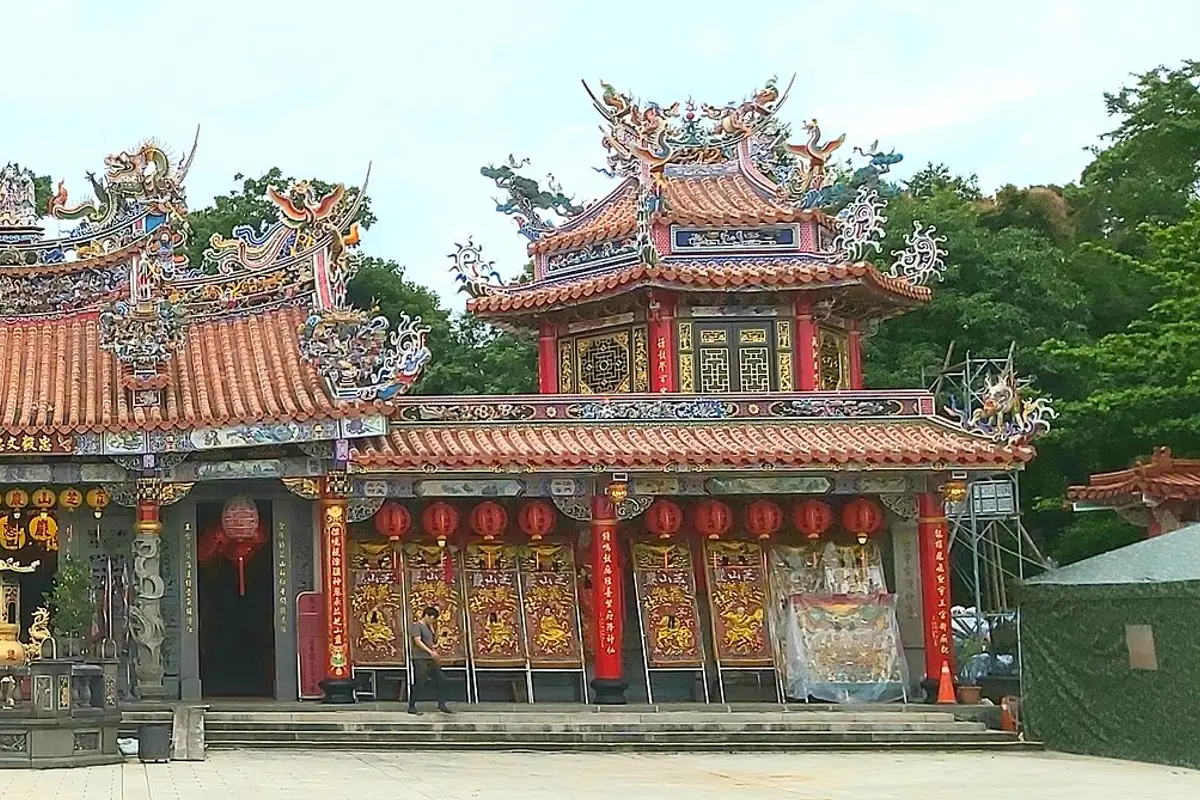
Chih Shan Yen Hui Chi Temple
芝山巖惠濟宮· Temple
About
At the foot of the hill below the temple is a grassy square with model sheep, as if early settlers had grazed flocks here. Steps lead up through dim woods past moss-covered rock faces with an old feel.
Read more
On the way is a stone arch, a historic relic of Zhishan. Beyond it the path widens and, after a bend, opens onto level ground where Chih Shan Yen Hui Chi Temple stands. Settlers from Zhangzhou brought their guardian god, Kaizhang Shengwang, with them to Shilin. According to legend, Zhishan was once the land of a wealthy man, Huang Shan. His relative Huang Chengqing, from Pinghe County in Zhangzhou Prefecture, brought an incense token of Kaizhang Shengwang to Taiwan and hung it on Zhishan. Miracles were said to follow, so people pooled their money and built the temple in 1752. Soon afterwards, because Guanyin was also worshipped here, it was also called Zhishanyan Temple. In 1840 Pan Yongqing, a member of the Shilin gentry, founded a Wenchang shrine on Zhishanyan and hired teachers to educate local children. In 1874 the three temples were merged and have since been known together as Hui Chi Temple. Most visitors come to pray for success in exams. The temple has a Wenchang brush: it is said that touching it brings blessings, so parents bring their children to touch it and pray for exam success.
Translated and shortened by DealTaipei from Taiwan's national tourism database. Sources are on the terms page.
Facts and sources
- Names
- EN Chih Shan Yen Hui Chi Temple中文 芝山巖惠濟宮日本語 芝山巖惠濟宮 Wikidata Q15909498; English by DealTaipei, Chinese from the listing
- District
- Shilin District · 士林區 Tourism Administration listing, updated 2026-05-20
- Opening hours
- Not in the listing Tourism Administration listing, read 2026-09-30
- Phone
- (02)28315656 Tourism Administration listing. May be Chinese only
- Data
- /api/sight/chih-shan-yen-hui-chi-temple.json The same facts as JSON, for apps and AI agents
Getting there

 Shilin Shennong Temple Temple · 740 m away Zhishan Cultural and Ecological Garden Park and garden · 173 m away Zhishan Park Park and garden · 176 m away Shuangxi Living Waterfront Cycle Path Cycle path · 451 m away
 Shuangxi Park and Chinese Garden Park and garden · 739 m away Guo Yuanyi Pastry Museum Museum · 917 m away
Wikidata (CC0). Sources and photo credits are on the terms page.