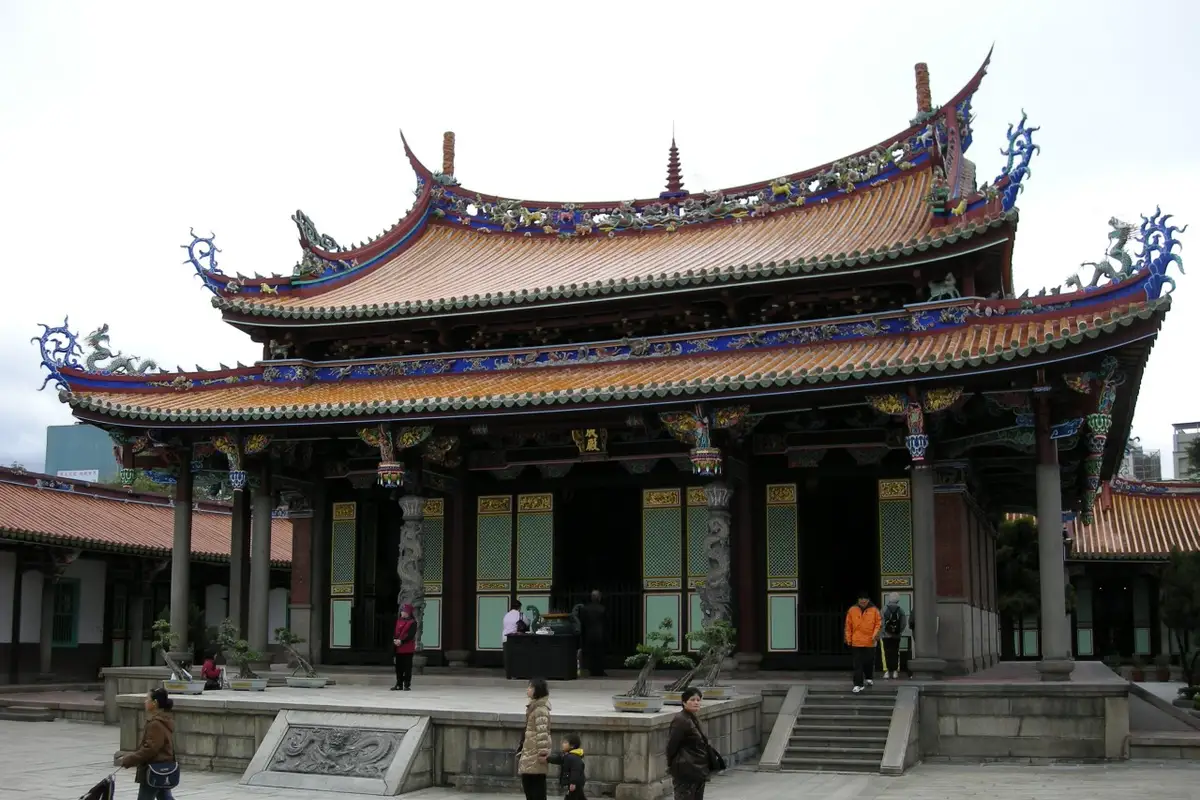
Taipei Confucian Temple
臺北孔廟· Temple
About
Construction of Taipei Confucian Temple began in 1927. It stands among the old streets of Dalongdong, a neighbourhood with a strong scholarly tradition.
Read more
Under an urban renewal plan by the Taipei City Government, the temple, Dalong Elementary School and Bao'an Temple form the Dalongdong cultural area of 'temple, school and palace'. The temple is a place of ceremony, a symbol of Confucian learning and a city-designated historic site. It follows the architectural form of the original Confucian temple in Qufu, and its beams, pillars, doors and windows carry no inscriptions, giving it a plain and solemn look. The layout runs, in order, through the Wanren Wall, the Pan Pool, Lingxing Gate, Yi Gate, Dacheng Hall and Chongsheng Shrine. Unlike those of other temples, none of the pillars, doors or windows bear couplets; it is said this is because no one dared to show off their writing at the door of Confucius. Because the temple was built by private citizens, it adds regional decoration to the standard form, namely the jiaozhi pottery and jiannian (cut porcelain) work typical of southern Fujian. Its jiaozhi pottery is an unusual example among Confucian temples in Taiwan. The main hall, Dacheng Hall, holds the spirit tablet of Confucius in the central shrine, beneath a black plaque with gold characters reading 'Education for all, without distinction'. Along the side walls are the tablets of the Four Correlates (Yanzi, Zengzi, Zisi and Mencius) and the Twelve Wise Ones. The many jiaozhi pottery friezes in Dacheng Hall are a feature unique among Confucian temples in Taiwan. The temple has few statues or altar objects, but it holds many ritual vessels and musical instruments made to ancient specifications. At the Shidian ceremony on 28 September each year, music and dance are performed and offerings of livestock and wine are presented in honour of Confucius. The temple has an artefacts exhibition room and a multimedia exhibition room explaining the temple and the ritual vessels and instruments of the ceremony, as well as a Bayi (eight-row dance) instrument display centre where pressing the illustrated panel plays the sound of each instrument, some deep and some clear and high. A guide system is available in Mandarin, English, Japanese and Korean. The temple also holds events combining traditional and modern arts, including the annual Dalongdong Cultural Festival, which introduces ritual culture and Confucian thought. Minglun Hall houses a 4D virtual reality theatre that presents the history of the temple and the life of Confucius with immersive special effects.
Translated and shortened by DealTaipei from Taiwan's national tourism database. Sources are on the terms page.
Facts and sources
- Names
- EN Taipei Confucian Temple中文 臺北孔廟日本語 台北孔子廟 Wikidata Q136181, Chinese from the listing
- District
- Datong District · 大同區 Tourism Administration listing, updated 2026-05-20
- Opening hours
- Not in the listing Tourism Administration listing, read 2026-09-30
- Phone
- (02)25923934 Tourism Administration listing. May be Chinese only
- Data
- /api/sight/taipei-confucian-temple.json The same facts as JSON, for apps and AI agents
Getting there

 Huguo Chan Buddhist Temple of the Linji School Temple · 432 m away Datou Drum Pavilion Temple · 1413 m away
 Dadaocheng Cisheng Temple Temple · 1481 m away Dalong Street Night Market Night market · 181 m away Shifang Yueji Music Theatre Theatre and venue · 479 m away MRT Green Corridor Park and garden · 518 m away

Wikidata (CC0). Sources and photo credits are on the terms page.