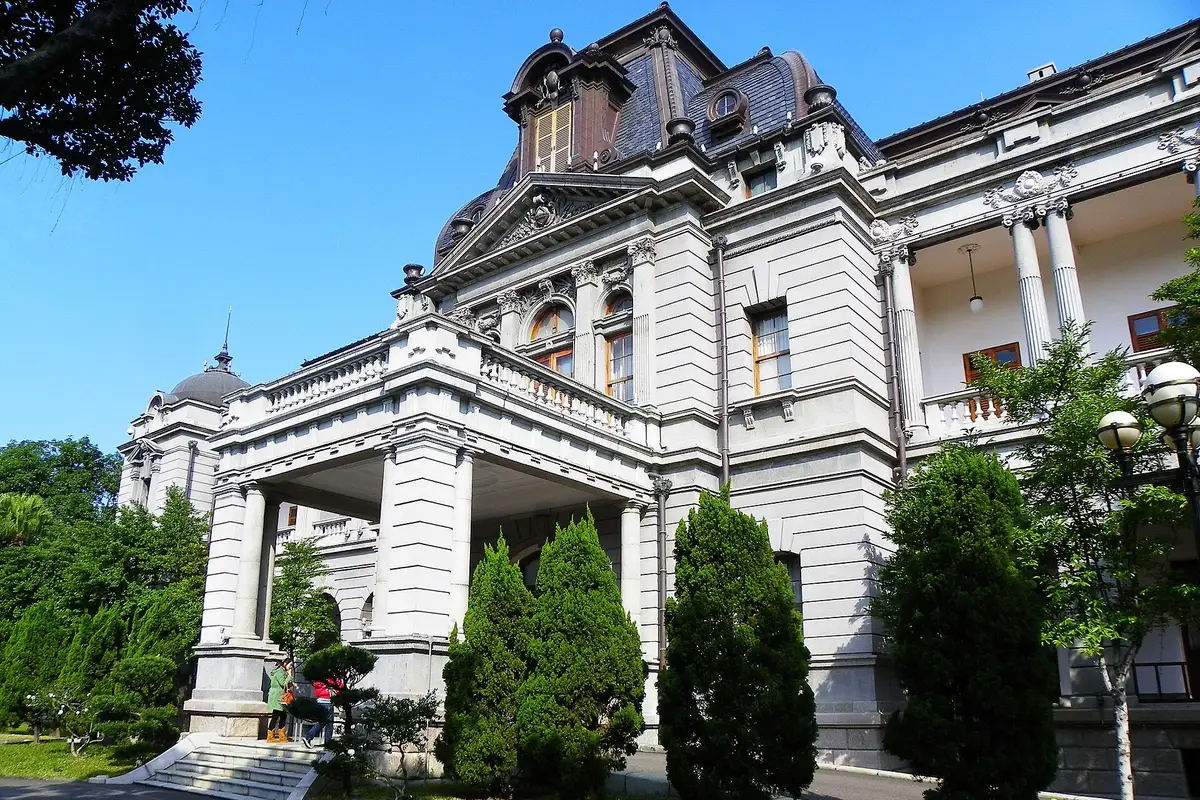
Taipei Guest House
臺北賓館· Historic site
About
This building has long been at the centre of Taiwan's political life. It began as the official residence of the Governor-General of Taiwan during the Japanese colonial period.
Read more
After Taiwan's retrocession it served as the official residence of the provincial governor, and in 1950 it was renamed the Taipei Guest House. It became an important state venue for state banquets, receiving foreign guests, party and government meetings and cultural events. In 1998 the Ministry of the Interior designated it a national monument. Construction began in 1899 to a design by the Japanese architects 宮尾麟 and Nomura Ichiro. In 1911 it was rebuilt to a design by Moriyama Matsunosuke, which gave it its present appearance. In 2002 it closed for its most extensive renovation since the retrocession, which was completed in May 2006. As part of Taiwan's democratisation, it opened to the general public for the first time on 4 July 2006. The site is a long rectangle running east to west, and the main building faces south. It is a two-storey structure of brick, stone and reinforced concrete. Influenced by the Western historical styles that Japan adopted after the Meiji Restoration, it has a mansard roof, Greek pediments, Roman columns and ornate Baroque-style carved decoration. Wide verandas on all four sides resemble the official buildings of European and American colonial cities in Southeast Asia. At the south-east corner of the third level is a terrace, from which parades and the street could be watched on festive occasions. During the Japanese period the residence was used not only as the Governor-General's home but also for administrative work and for receiving and entertaining guests. The first major event after its completion was the reception of Princess Tomiko, consort of Prince Kitashirakawa Yoshihisa, who came to Taiwan in October 1901. It went on to receive other members of the imperial family and nobility, including Prince Kan'in Kotohito, Prince Chichibu Yasuhito, Prince Takamatsu Nobuhito and Yi Un, King Yi of Changdeok Palace. The most important of these was the visit of Crown Prince Hirohito (later Emperor Showa) in 1923. During his stay he mainly used the upper floor, and the audiences given to officials and local gentry were held in the large reception room there. On his first day, the Governor-General had him climb the spiral staircase to the terrace on the third level to receive the cheers of the parading crowds. After the retrocession the building was no longer the Governor-General's residence, but it remained the government's main venue for meetings and for banquets for foreign guests. Successive presidents received many distinguished guests on the ground floor. The best known were Japanese Prime Minister Kishi Nobusuke in 1957, Singaporean Prime Minister Lee Kuan Yew in 1981, former US President Clinton in 2005 and Chen Yunlin, chairman of mainland China's Association for Relations Across the Taiwan Straits, in 2008. The government has also signed many important international treaties and agreements in the banquet hall. The most important is the Sino-Japanese Peace Treaty, signed in 1952 by Foreign Minister Ye Gongchao and Japan's plenipotentiary Kawada Isao, which had great bearing on Taiwan's sovereign status. Among later signings, the best known are the International Covenant on Civil and Political Rights and the International Covenant on Economic, Social and Cultural Rights, signed by President Ma Ying-jeou on 14 May 2009. These marked an important step for the country in joining the international human rights system and widening its cooperation on human rights.
Translated and shortened by DealTaipei from Taiwan's national tourism database. Sources are on the terms page.
Facts and sources
- Names
- EN Taipei Guest House中文 臺北賓館한국어 타이베이 빈관日本語 台北賓館 Wikidata Q3699230, Chinese from the listing
- District
- Zhongzheng District · 中正區 Tourism Administration listing, updated 2026-05-22
- Opening hours
- Not in the listing: see the official site Tourism Administration listing, read 2026-09-30
- Phone
- (02)23482999 Tourism Administration listing. May be Chinese only
- Official site
- subsite.mofa.gov.tw/TGHWikidata
- Data
- /api/sight/taipei-guest-house.json The same facts as JSON, for apps and AI agents
Getting there


 Memorial to the Victims of the White Terror Historic site · 274 m away
  Chiang Kai-shek Memorial Hall Historic site · 481 m away
  Presidential Office Building Historic site · 484 m away South Gate (Lizheng Gate) Historic site · 584 m away
 Wikidata (CC0). Sources and photo credits are on the terms page.