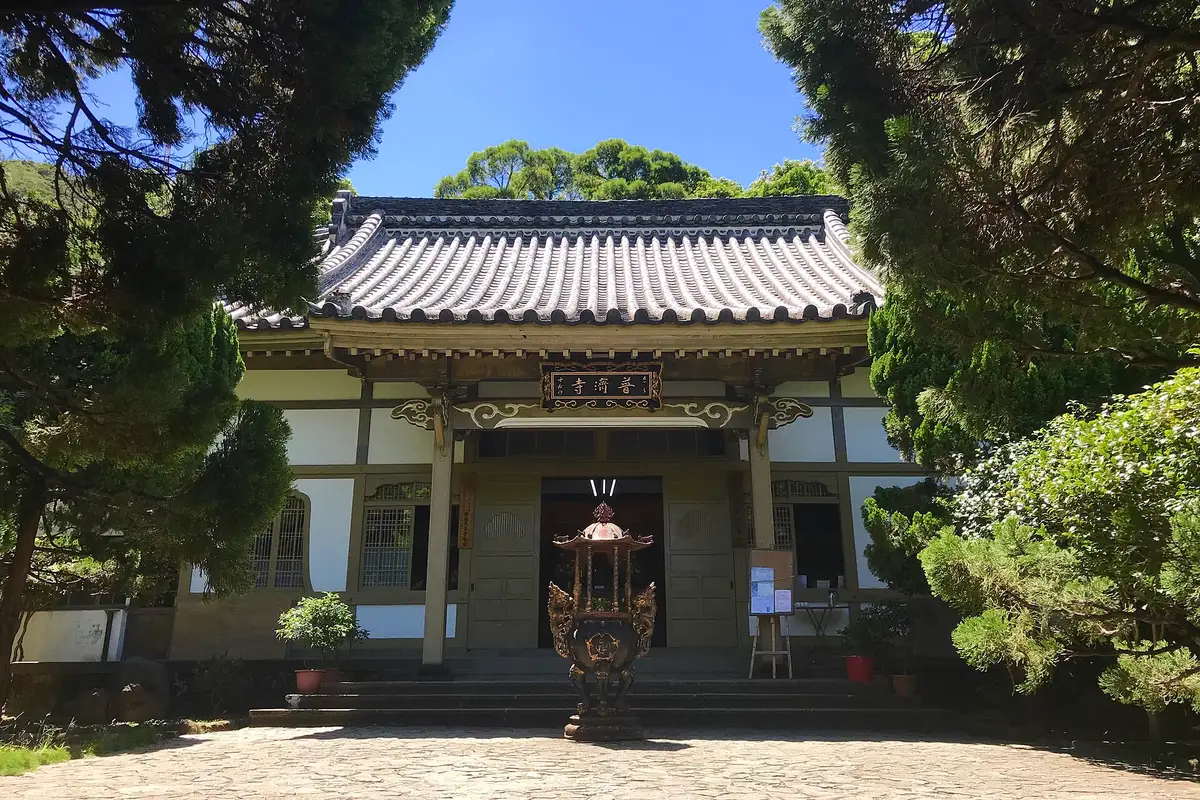
Beitou Puji Temple
北投普濟寺· Temple
About
According to a guide to famous Buddhist sites in Taiwan published in 1941 by the Minde Photo Studio in Taipei, Puji Temple and the Huguo Chan Buddhist Temple of the Linji School, also a Taipei City monument, were both mission centres of the Myoshinji branch of the Linji (Rinzai) school in Taipei. When the temple was rebuilt in 1934, most of its followers worked for the Railway Department of the Transport Bureau of the Government-General of Taiwan, so it was named Tiezhen Yuan after 'Tiezhen', the posthumous name of the head of the department's transport section, and a monument to him was set up in the temple. It was listed as a city monument in 1998. The temple is clearly Japanese in style. The main hall has a single-eaved hip-and-gable roof and is three bays wide and three bays deep, nearly square, with the roof extending forward to form the entrance porch. Inside, the raised floor of the hall is laid with tatami. The main hall is built of high-grade cypress. The temple still follows Japanese forms of worship, unlike traditional Taiwanese practice. The bell-shaped windows beside the main door are distinctive, the entrance porch has bracket sets and carved rainbow beams, and the plaque bearing the name Puji Temple was written by Yu Youren. In a pavilion to the left of the temple is a stone figure holding a baby in the left arm and a monk's staff in the right. Many people take it to be Songzi Guanyin, while Buddhists regard it as the Japanese Zi'an (Koyasu) Bodhisattva, one of the forms of Dizang Bodhisattva, and many worshippers come here to pray for children. The Tangshou Guanyin and the Zi'an Bodhisattva are two of the temple's distinctive features.
Translated and shortened by DealTaipei from Taiwan's national tourism database. Sources are on the terms page.
Getting there

Good to know




Wikidata (CC0). Sources and photo credits are on the terms page.